We are processing your request.
Please, don’t close or refresh the page.

Smith Tower History: Seattle’s First Skyscraper

How a typewriter fortune built the tallest tower west of the Mississippi in 1914, and what the story means for your visit to the 35th-floor observatory.

Visit

The history exhibits and the 35th-floor observatory are included with entry: Smith Tower tickets.

Location

506 Second Ave, Seattle, WA 98104, in Pioneer Square. Address and directions.

Opening hours

Open daily from 12 p.m., with last admission one hour before closing. Smith Tower opening hours.

Key fact

Smith Tower opened on July 4, 1914, at a completed height of 469 feet.

Smith Tower was Seattle’s first skyscraper and, when it opened on July 4, 1914, the tallest building west of the Mississippi. It held the title of the city’s tallest building until the Space Needle went up in 1962, and its white terra cotta shaft and pyramid top still stand out at the corner of Second Avenue and Yesler Way.

Much of the building’s story is told inside: an observatory ticket includes self-guided history exhibits as well as the open-air observatory on the 35th floor. This guide sets out the timeline, the people behind the tower and the details to look for when you go up. For hours, transport and the bar, see our Smith Tower visitor guide.

4.6
(24)

Smith Tower Observatory: Entry Ticket + Self-Guided Tour

Highlights

Discover the rich history of the Smith Tower in Downtown Seattle’s Pioneer Square district.

Enjoy breathtaking city views from this iconic skyscraper’s observation deck.

Experience a unique self-guided tour at your own pace.

Visit notable features like the Wishing Chair located on the thirty-fifth floor.

Relax in the observatory’s bar and enjoy its classic architectural ambiance.

Smith Tower history: key facts

Lyman Cornelius Smith bought the lot at Second and Yesler in May 1899.

Construction officially began on November 1, 1911, and the last rivet of the frame was driven on February 15, 1913.

The tower opened on July 4, 1914, at a completed height of 469 feet, with a pinnacle height of 522 feet.

Over 4,000 people rode the original Otis elevators to the 35th-floor observatory on opening day.

It was the tallest building west of the Mississippi until 1931 and the tallest in Seattle until 1962.

The building was designated a Seattle landmark on June 12, 1984.

From a 14-story plan to a 42-story tower
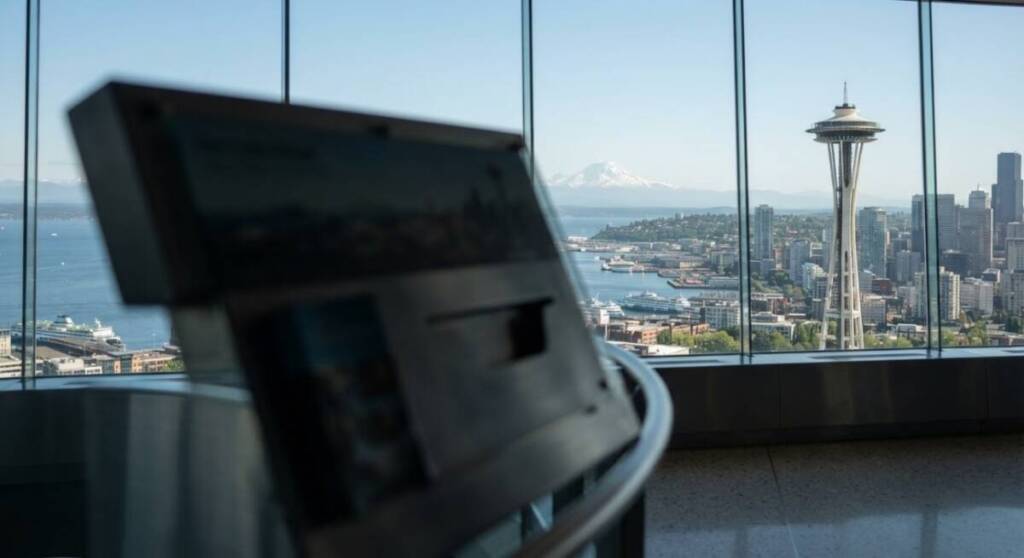
  • The story starts in May 1899, when Lyman Cornelius Smith, a Syracuse industrialist known for typewriters and firearms, bought an oddly shaped lot at Second and Yesler in downtown Seattle. His first plan, in 1909, was a 14-story building.

    His son, Burns Lyman Smith, persuaded him to think bigger and to beat Tacoma’s National Realty Building as the tallest building west of the Mississippi. In February 1910, architect Edwin H. Gaggin of Gaggin & Gaggin arrived from Syracuse with plans for 26 stories. By June 1910, L.C. Smith was announcing a 40-floor building, on the condition that the city’s civic center stay on the neighboring block.

    In October 1910, B.L. Smith and Gaggin returned with the final design: a 467-foot, 42-story tower. L.C. Smith died in 1910 and did not live to see construction begin, so his son oversaw the project.

Building it: 1911 to 1914

The final building permit was issued on February 24, 1911. That September, the New York-based Whitney-Steen Company signed the general construction and excavation contracts and brought in the American Bridge Company to supply and assemble the steel frame.

Selective demolition on November 1, 1911, marked the official start of construction, and the last rivet of the frame was driven on February 15, 1913. The structure is a steel frame with concrete, faced with granite at the base and white terra cotta on the upper floors.

On July 4, 1914, the building opened to the public at a completed height of 469 feet and a pinnacle height of 522 feet. More than 4,000 Seattleites rode the original Otis elevator to the 35th-floor observatory that day.

The record height and how long it lasted

Smith Tower was the tallest building west of the Mississippi until 1931, when the Kansas City Power & Light Building was completed. On the West Coast and in Washington, it kept the lead much longer: it was Seattle’s tallest building from 1914 until the Space Needle in 1962.

The building carried the L.C. Smith Building name for its first years, and the Smith Tower name became official in 1929. Today the pyramid roof is topped by an 8-foot glass dome that glows blue, switching to green in December.

Elevators, the Wishing Chair and other details
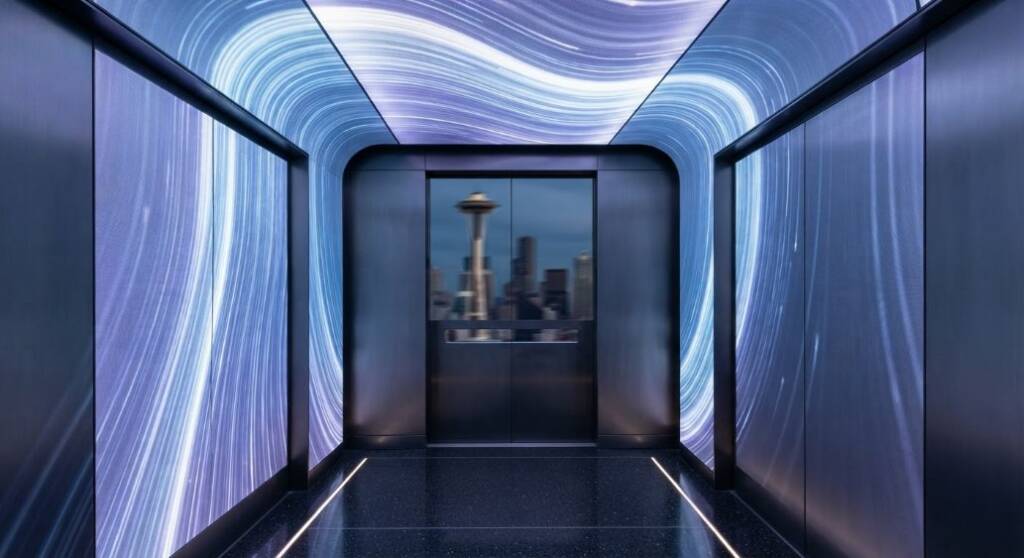
  • The elevators are part of the history. Otis Elevator Company supplied the original cars, finished in brass, and Smith Tower was one of the last buildings on the West Coast to use elevator operators. The elevators were automated and modernized starting in 2017, and the ride up is still part of the visit.

    The best-known piece of folklore is the Wishing Chair, carved with a dragon and a phoenix. Legend says an unmarried person who sits in it will be married within a year, and the story goes that it came true for Smith’s daughter.

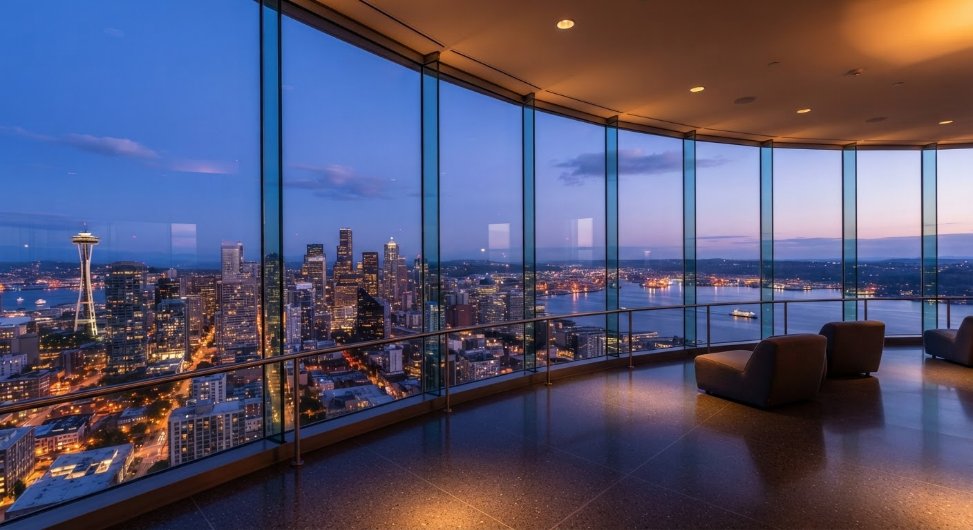
    The 35th-floor room once known as the Chinese Room had a carved teak ceiling and blackwood furniture. After the 2015 to 2016 renovation, the observation floor reopened with a speakeasy-style bar, and the room’s old name was retired.

Owners, renovations and landmark status

Ivar Haglund, founder of the Ivar’s seafood restaurants, bought the tower in 1976 for $1.8 million. The building was renovated in 1986 and 1999, and during a restoration the old water tank in the pyramid was removed; that space became a three-story penthouse, the building’s only residence.

The building was designated a Seattle landmark on June 12, 1984. A 2015 to 2016 remodel reopened the observation floor, and the revised visitor experience resumed in August 2016. In 2024, a group led by GT Capital became the latest owner.

Smith Tower timeline at a glance

May 1899: L.C. Smith buys the lot at Second and Yesler.

1909: a 14-story building is planned.

October 1910: final plans for a 42-story tower are presented.

November 1, 1911: construction officially begins.

February 15, 1913: the last rivet of the frame is driven.

July 4, 1914: the tower opens to the public.

1962: the Space Needle becomes Seattle’s tallest structure.

June 12, 1984: Seattle landmark designation.

2016: the renovated observatory and bar reopen.

Seeing the history on your visit

An observatory ticket includes the self-guided history exhibits, the 35th-floor open-air observatory and access to the Observatory Bar, where speakeasy-inspired cocktails nod to the Prohibition era. Most guests spend 45 minutes to 2 hours in the building.

For more of the story, the Talking Tower Tour is a 45-minute guided tour that covers the exhibits, the elevators, the observatory and the main lobby, and it runs every hour. Arrive early for sunset, when short waits for the elevator are common, and pick your time with the ticket options on this page. Hours are on our opening hours guide.

Smith Tower history: frequently asked questions

When was Smith Tower built?

Construction officially began on November 1, 1911, and the steel frame was finished on February 15, 1913. The tower opened to the public on July 4, 1914.

Who built Smith Tower?

Smith Tower was commissioned by Lyman Cornelius Smith, a Syracuse industrialist known for typewriters and firearms. He died in 1910, and his son Burns Lyman Smith oversaw the project, designed by Gaggin & Gaggin of Syracuse.

How tall is Smith Tower?

Smith Tower opened at a completed height of 469 feet, with a pinnacle height of 522 feet. The final plans were for a 42-story building.

Was Smith Tower the tallest building west of the Mississippi?

Yes. When it opened in 1914 it was the tallest building west of the Mississippi, a title it held until 1931. It remained Seattle’s tallest building until the Space Needle in 1962.

Is Smith Tower the oldest skyscraper in Seattle?

Smith Tower is known as Seattle’s first skyscraper. It opened in 1914 and was designated a Seattle landmark in 1984.

What is the Smith Tower Wishing Chair?

The Wishing Chair is a carved chair decorated with a dragon and a phoenix. Legend says an unmarried person who sits in it will be married within a year, and the story goes that it came true for Smith’s daughter.

Does Smith Tower still have elevator operators?

Smith Tower was one of the last buildings on the West Coast to use elevator operators. Its brass Otis elevators were automated and modernized starting in 2017.

Who owned Smith Tower?

Ivar Haglund, founder of Ivar’s restaurants, bought the tower in 1976. Later owners include Unico Properties and, since 2024, a group led by GT Capital.

Does anyone live in Smith Tower?

The pyramid top holds a three-story penthouse, the building’s only residence. It was created after the old water tank was removed during a restoration.

Are the history exhibits included with an observatory ticket?

Yes. The self-guided history exhibits are part of the observatory ticket. The ticket also includes the 35th-floor open-air observatory and the Observatory Bar.

About this guide

Sources: Smith Tower, History; Smith Tower, FAQ; Smith Tower, Tours; Smith Tower, Observatory and Bar; Wikipedia, Smith Tower.

This website offers official tickets for the venues listed, sold by Tourism Tickets. Please note, however, that it is not the official website of any of these venues.

The images and videos on this website may contain visual elements that have been created or enhanced using AI technology. They are provided for illustrative purposes only.